I think these new labels are a just great, don't you? They're much more eye-popping than the old ones. I'm so pleased...
Wednesday, July 25, 2012
New Soap Label Art
Introducing the new packaging for Fish Tale Soap, Sasquatch Soap and Lavender Lover Soap!
I think these new labels are a just great, don't you? They're much more eye-popping than the old ones. I'm so pleased...
Thursday, July 19, 2012
Repurposed TicTac Boxes for Travel Spices
The URL for this post has moved.
You will be automatically redirected in 3 seconds.
Please update your links accordingly.
Thanks!
Friday, July 13, 2012
Tough Chick Soap
I have a new One Batch bare bar soap available on the website today. It's called Tough Chick Soap because it's a mixture of floral, feminine sweetness and rough and tough ground organic oats. It's scented with fine French lavender essential oil and is made with honey from the Ballard Bee Company. The smell is a complex, sweet floral. It's lovely. You should try some!
Labels:
handcrafted,
handmade,
honey,
seattle sundries,
soap
Thursday, July 12, 2012
Mountain Beaver Capitol of the Known Universe
A continuation of The Saga...
Part 1 Part 2 Part 3
Part 4: My husband spotted a NEW interloper in our rockery yesterday while he was gardening. This guy is even less attractive. And look how he's trying to stare me down. Or maybe he's trying to smile for the camera. He didn't even try to run away. What cojones!
We've named this guy Beavis.
Repurposed Camping Matches Container
Look at the cool little thing that I put together to hold our matches when we go camping!
I got the idea from this blog post, which I think is really cute but sort of impractical for camping because of the glass. We occasionally buy gum in these plastic containers
that I realized would be perfect to repurpose for the job because it won't break, yet will keep the matches nice and dry. I added super fine sandpaper to both the outside and inside of the lid, so there's plenty of place to strike a flame.
You might also want to read my Family Camping Essentials List.
Saturday, June 30, 2012
Britt's Beekeeping, Part 3: The Queen Bee
A good friend of mine recently made a trip home to Boise to visit her family and had the opportunity to learn about some local honey beekeeping efforts. She's been talking about getting a hive for her yard here in Seattle for some time, so was an eager student as she learned about many of the details of bees and beekeeping. She took incredible pictures, which she posted on Facebook, and added very informative captions for each one. I thought they were so great that I asked if I could highlight them here on Skruben as well. She said "great!" Here is the final installment of Britt's Beekeeping...
The Queen Bee:
When the queen is introduced to a hive, she's inserted in a
small mesh box with a fondant plug. After the two days it takes the workers to
eat their way through, they're used to her scent and she's welcome rather than
killed as an intruder.
There are multiple breeds of honeybees. The hive is a blend
of a couple of different swarms and this queen is from a generally placid
breed. She should produce happy, mellow bees.
One thing to look for when checking a hive is too many drone
cells. The queen only takes one 2-3 day long mating flight in her lifetime, so
not many are needed. A drone can mate within one week of hatching. Once he
does, he dies. He's got no stinger and buggier eyes.
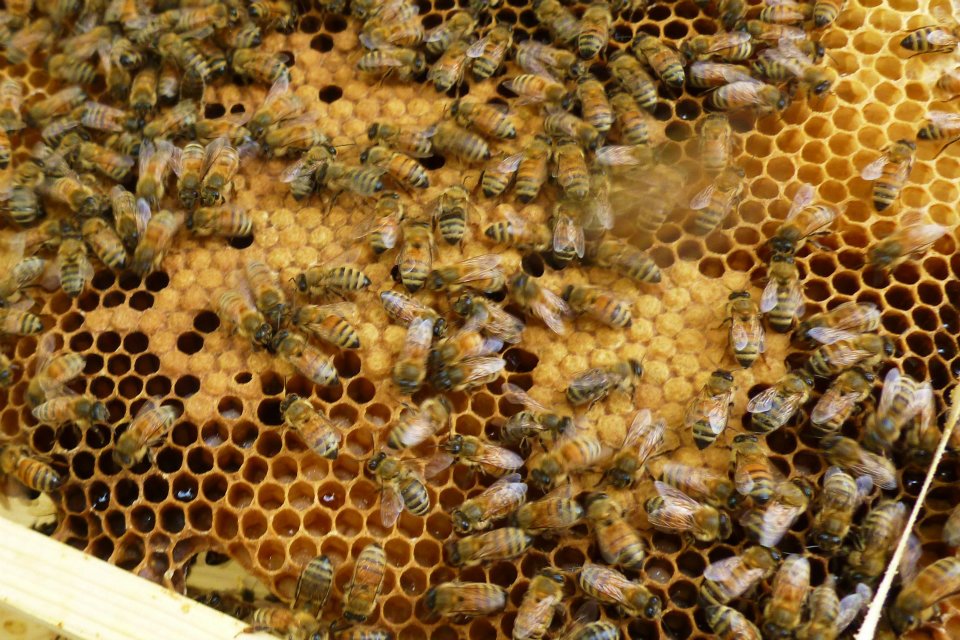
Typically, brood cells - and the queen - are in the center
of the box. The outer frames are the honey cells.
She will lay about 1500 eggs a day, so she's pretty mobile.
She does nothing else after her mating flight.
Here we are, looking for the queen. It takes a month for a queen-less
hive to produce a queen that can lay. By that time, the drones can outnumber
the workers and the hive is often irreparably out of balance. This is why it's
important to keep an eye out for the queen.
Still looking for the Queen. Three bee hoods make for a
tricky huddle.
There's the queen! Though she can live for several years,
most beekeepers "retire" their queens after one. Some are set into
smaller boxes as back-up queens. Others are just squished.
Now that she's been marked (with an enamel paint pen), she
should be somewhat easier to find during hive checks.
Once these frames are full of honey, a queen excluder will
be added on top and a new box will be added. Her hips are too wide to fit
through the excluder, but the workers can easily move up to the new box.
Any honey above these two boxes, which the bees need to
survive the winter, may be harvested. Depending on how the summer goes, there
might be a harvest this year!
Friday, June 29, 2012
Britt's Beekeeping, Part 2: Honeycomb
A good friend of mine recently made a trip home to Boise to visit her family and had the opportunity to learn about some local honey beekeeping efforts. She's been talking about getting a hive for her yard here in Seattle for some time, so was an eager student as she learned about many of the details of bees and beekeeping. She took incredible pictures, which she posted on Facebook, and added very informative captions for each one. I thought they were so great that I asked if I could highlight them here on Skruben as well. She said "great!", so here is Part 2 of Britt's Beekeeping...
Honeycomb:
Here's pretty new honeycomb. Two weeks ago, only the black
starting plastic was there.
Here's more established comb.
The rubber bands are holding in rescued comb from a hive in a house's walls.
Burr comb is excess honeycomb -- not particularly useful to
the hive. It makes it tougher to move the frames in and out. They're often used
for drone cells, as well.
These are all honey cells. Once they're full, the bees cap
them with wax. They build comb on both sides of the frame.
That more bullet-shaped cell 8:45 of center is a drone cell,
I believe. They are larger and more conical. If the queen disappears, the
workers can start laying drone eggs. Since the drones do nothing but mate with
the queen and be fed by the workers, a hive overrun with drones is bad news.
In this picture, you can see the little larvae pretty well -
the half-moon wormy shrimp dudes. They're about 10 days along, I think. The
eggs, which I didn't spot, float in royal jelly when they're laid.
In the next installment of Britt's Beekeeping...Part 3: The Queen Bee
All photos courtesy of Britt McCombs
Subscribe to:
Posts (Atom)