Showing posts with label environment. Show all posts

Saturday, June 30, 2012

Britt's Beekeeping, Part 3: The Queen Bee

A good friend of mine recently made a trip home to Boise to visit her family and had the opportunity to learn about some local honey beekeeping efforts. She's been talking about getting a hive for her yard here in Seattle for some time, so was an eager student as she learned about many of the details of bees and beekeeping. She took incredible pictures, which she posted on Facebook, and added very informative captions for each one. I thought they were so great that I asked if I could highlight them here on Skruben as well. She said "great!"  Here is the final installment of Britt's Beekeeping...


The Queen Bee:

When the queen is introduced to a hive, she's inserted in a small mesh box with a fondant plug. After the two days it takes the workers to eat their way through, they're used to her scent and she's welcome rather than killed as an intruder.

There are multiple breeds of honeybees. The hive is a blend of a couple of different swarms and this queen is from a generally placid breed. She should produce happy, mellow bees.

One thing to look for when checking a hive is too many drone cells. The queen only takes one 2-3 day long mating flight in her lifetime, so not many are needed. A drone can mate within one week of hatching. Once he does, he dies. He's got no stinger and buggier eyes.
Typically, brood cells - and the queen - are in the center of the box. The outer frames are the honey cells.

She will lay about 1500 eggs a day, so she's pretty mobile. She does nothing else after her mating flight.


Here we are, looking for the queen. It takes a month for a queen-less hive to produce a queen that can lay. By that time, the drones can outnumber the workers and the hive is often irreparably out of balance. This is why it's important to keep an eye out for the queen.


Still looking for the Queen. Three bee hoods make for a tricky huddle.


There's the queen! Though she can live for several years, most beekeepers "retire" their queens after one. Some are set into smaller boxes as back-up queens. Others are just squished.


Now that she's been marked (with an enamel paint pen), she should be somewhat easier to find during hive checks.


Once these frames are full of honey, a queen excluder will be added on top and a new box will be added. Her hips are too wide to fit through the excluder, but the workers can easily move up to the new box.


Any honey above these two boxes, which the bees need to survive the winter, may be harvested. Depending on how the summer goes, there might be a harvest this year!

Friday, June 29, 2012

Britt's Beekeeping, Part 2: Honeycomb

A good friend of mine recently made a trip home to Boise to visit her family and had the opportunity to learn about some local honey beekeeping efforts. She's been talking about getting a hive for her yard here in Seattle for some time, so was an eager student as she learned about many of the details of bees and beekeeping. She took incredible pictures, which she posted on Facebook, and added very informative captions for each one. I thought they were so great that I asked if I could highlight them here on Skruben as well. She said "great!", so here is Part 2 of Britt's Beekeeping...

Honeycomb:

Here's pretty new honeycomb. Two weeks ago, only the black starting plastic was there.


Here's more established comb.


The rubber bands are holding in rescued comb from a hive in a house's walls.


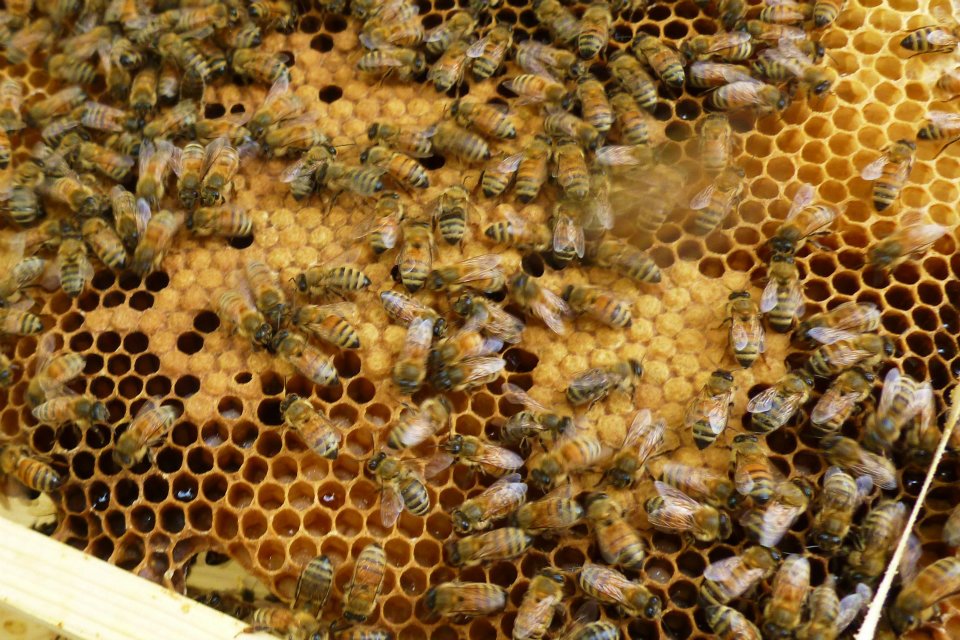
Burr comb is excess honeycomb -- not particularly useful to the hive. It makes it tougher to move the frames in and out. They're often used for drone cells, as well.


Britt with burr comb.


These are all honey cells. Once they're full, the bees cap them with wax. They build comb on both sides of the frame.


These darker cells are filled with worker bee larvae. They're nearly ready to hatch.


That more bullet-shaped cell 8:45 of center is a drone cell, I believe. They are larger and more conical. If the queen disappears, the workers can start laying drone eggs. Since the drones do nothing but mate with the queen and be fed by the workers, a hive overrun with drones is bad news.


In this picture, you can see the little larvae pretty well - the half-moon wormy shrimp dudes. They're about 10 days along, I think. The eggs, which I didn't spot, float in royal jelly when they're laid.


In the next installment of Britt's Beekeeping...Part 3: The Queen Bee

All photos courtesy of Britt McCombs

Thursday, June 28, 2012

Britt's Beekeeping, Part 1: Bee Basics

A good friend of mine recently made a trip home to Boise to visit her family and had the opportunity to learn about some local honey beekeeping efforts. She's been talking about getting a hive for her yard here in Seattle for some time, so was an eager student as she learned about many of the details of bees and beekeeping. She took incredible pictures, which she posted on Facebook, and added very informative captions for each one. I thought they were so great that I asked if I could highlight them here on Skruben as well. She said "great!", so here is Part 1 of Britt's Beekeeping...


Bee Basics:
This is the hive.  There are two stacked boxes which contain frames that can be slipped out from the top.  Smoking the hive makes the bees crave honey so they stay down in the combs and are less likely to sting, or leave.


This is the bees' ground floor entrance to the hive.  


There's another entrance in both boxes. The top one leads to the sugar water (simple syrup) feeders.


This is the sugar water feeder. Right now, they're drinking almost a gallon of sugar water every two days. The more of it they drink, the less they'll eat the honey.


The bees eat honey. The pollen they collect is fed to the larvae. A bee produces about 1/4 teaspoon of honey in her lifetime.


The yellow-legged bees have full pollen sacks. They can visit up to 2000 flowers a day, but only carry 50-100 flowers' worth at a time.  The most productive worker bees may wear their bodies out after 2-3 weeks. Worker bees can live 2-3 months in the active season.


On the warmest days, some workers stand at the entrance and fan with their wings to lower the hive temperature to 93 degrees Fahrenheit.  Over the winter, bees can live longer. They huddle around the brood (egg) cells and take turns vibrating their bodies to maintain the 93 degree environment.


Workers have multiple roles in their lives. The youngest produce wax flakes from chest glands that other workers chew and soften to build the combs.  All these workers are imperfect females, meaning they can't lay eggs that become workers.


Bees also produce propolis, which is a very very sticky, dark orange, resinous substance that they get from plant sap and they use to hold things together in the hive. It has to be loosened to lift out the frames.  A full frame weighs about 8 pounds.


In the next installment of Britt's Beekeeping...Part 2: Honeycomb

All photos courtesy of Britt McCombs

Sunday, February 5, 2012

4-H Does Paleoclimatology

Our 4H club had the awesome opportunity this week to tour the University of Washington Ocean Sciences building and learn about the Paleoclimatology & Organic Geochemistry Research being done there.  We feel really fortunate to have access to this great teaching, learning and research institution.  The visit was a wonderful example for the kids of what can be accomplished with an interest in the natural world combined with a solid game plan and lots of hard work.

Paleoclimatology is the study of changes in climate over the entire history of the Earth.  Researchers learn about these changes by looking at ocean currents, temperatures, salinity, atmospheric gasses and very, very old slices of history...literally.  Much of their data comes from deep sediment and ice core samples collected in various places all over the world.  Information about what our atmosphere was like thousands of years ago can be compared to today's data and much can be learned.

This is a device that collects samples in the open ocean.

We learned that our oceans are mapped just like our land masses are.

The kids were very interested in the nitty gritty, practical details of how data is collected by the research team.  Members of the team spend several months each year out in the field collecting data in places like   the Marshall Islands, Fiji and the Galapagos Islands.  The University has developed and manufactures self propelled Deepglider devices that travel through the oceans of the world collecting information in a much more efficient way than in the past when research boats and many people would be needed to achieve the same result.    

Deepgliders getting readied for testing.

The lab has a test tank where they are able to do trial runs with equipment before taking it out into the field.  We got to try it out for ourselves.


Many parts of the lab facilities contain high tech industrial-looking equipment.  It was a good reminder that science is not only about lab coats, beakers and microscopes.


There were temperature controlled rooms containing core sediment samples in various stages of analysis.  The oldest core sample we saw was 120,000 years old.  It was also interesting to learn that some really low-tech tools like cheese wire and plastic wrap play important roles in the whole process.


The researchers also look for information in living things like plants that help measure saline levels in the earth's oceans.  Every single variable has to be looked at in order for the research to be valid and meaningful.


It was fun to see evidence that this was a real, working lab with people leaving notes out for each other.  I leave notes out on my counter too, but mine usually say something like "buy peanut butter".  Hmmm.


The high point for most of the kids was when they got to see the power of liquid nitrogen which, at  -346°F,  is the coldest thing that exists on Earth.  We dipped several objects in liquid nitrogen (gummi bears, roses, bananas, pennies and balloons) and got to see how extreme cold effects different substances.  It's a well known fact that scientists kick everyone's butt in the party trick department.


Upon departure we were also reminded that scientists do humor too.


Thanks University of  Washington Paleoclimatogy & Organic Geochemistry folks!  And keep up the good work!

.

Wednesday, November 23, 2011

My Less-Toxic Life List


Reading Deanna Duke’s book The Non-Toxic Avenger: What You Don’t Know Can Hurt You has made me look much more carefully at the things that I do and the products I buy for my family.  It’s not realistic for me to think that we will be able to eliminate our exposure to questionable chemicals, but we can focus on reducing that exposure.  Hopefully our bodies can battle the toxins we do take in more easily on their own, if they’re not being completely bombarded with them.  As I mentioned in my last post on this topic, it’s a case of “pick your battles”.  Well, these are the battles I decided to pick…


First, a pat on the back for things that we already do:

Keep lots of houseplants-plants do an amazing job of purifying the air, naturally.  Apparently, they can help filter the air up to 100% over 24 hours in a closed environment, if you have enough of them.  But you DO have to remember to give them water so that they don’t die.  Damn.

Use stainless steel cookware-we invested a few years ago in a nice collection of All-Clad pots and pans.  We love them and now can feel especially good about the fact that they aren’t poisoning us every time we cook a meal.

Use Apple computer products-because of its lack of restricted chemicals like lead, mercury and arsenic (which many computers contain…yuck), PVC-free components, and long battery charge, Apple’s computers are far safer than their competitors.

NO antibacterial soap or cleaners-use natural, handcrafted soap.  Antibacterial soap is Evil.  It’s full of Triclosan, which is not only really bad for fish and other wildlife, but gets stored in the body long term and is linked to endocrine abnormalities, immune-system weakening and cancer.   It’s also usually loaded with synthetic fragrance, which contains phthalates and neurotoxins.

Eat organic-we don’t eat all organic food, but we try to choose the organic or natural options whenever possible.   For produce, I put special focus on avoiding the non-organic versions of items that are known to carry the most pesticides, and buying the ones that usually have less.  Having said that, if my kids are having a snack at a friend’s house and have to choose between a non-organic apple and a candy bar, I hope they choose the apple. 


Starting down the road to a less toxic life:

No more nonstick cookware-we don’t have much of it, but what we do have is going away.  This stuff is loaded with nasty chemicals and has a tendency to flake off after repeated use, so you basically end up eating Teflon chunks.  It’s gross and definitely not good for you.  For example, my husband will be getting this stainless steel bowl rice cooker for the holidays, to replace the non-stick one we currently have.  Shhh, don’t tell him.

Wash my hands more-as if the normal reasons for washing your hands weren’t enough, now I’m aware of the fact that most paper printed with thermal printer ink (like cash machine and register receipts) is full of BPA, which rubs off onto your hands, seeps into your skin and follows you wherever you go.  Cashiers often have extremely high levels of BPA in their blood.  If my kids ever get a job at 7-11, they’re wearing gloves to work.

Shop online more-one of things that’s most difficult for me in trying to be a chemical watchdog for my family is that there are so many to keep track of.  I use the Environmental Working Group’s Skin Deep Cosmetics Database to look up information on specific products, but if I don’t plan ahead and bring a list with me when I shop in stores, I can never remember all the chemicals that should be avoided.  If you shop online, it’s much easier to look up that information because you’re sitting at your computer already.

Bring a cheat sheet-some things I just won’t buy online, so I’m going to carry a list in my wallet of the most heinous and pervasive chemicals…and the many different names they go by.  Hopefully this will help me to make better choices when I shop.

No plastic in the microwave-I know this is not new information, but the book really reinforced for me the importance of heating food in containers made from glass or metal, since the chemicals in plastic leach so easily into the food, especially at higher temperatures.  I’ve let it slip in the past, but won’t any more.

Be  less American-by this, I mean buy the European versions of products, if possible.  The EU has much stricter laws regarding questionable chemicals, where the burden is on corporations to prove that an ingredient is safe before it goes into the product.  Many American companies offer European versions of the same popular brands they sell here, only without the garbage in them.  Why don’t they just sell them in the US since they’ve already spent money on reformulating the recipes, you ask?  Probably because they’re afraid of appearing culpable and being sued if/when people get sick or have reactions to the American versions.  If they change the formulas, it implies that they contained something bad in the first place.   Sheesh.

Be strong, mom-I vow to buckle less under the whining pressure of my children when they ask to buy crappy chemical-laced, un-naturally colored, heavily fragranced or highly processed consumables.  Or better yet, I’ll just try not to take them to the store with me in the first place.


The harder changes to swallow:

Electronics-there’s a high likelihood that living in a world filled with electronics and high-voltage transients (dirty electricity) could affect our bodies on a cellular level.  If you think about it, these high frequency technologies (like in microwave ovens, cell phones & wi-fi ) are pretty new.  They’ve all become common within my own lifetime.  Time has not yet tested how our bodies can process and adapt to this widespread electromagnetic exposure.  It’s really scary.  But I also value electronics and feel like the positive impact they have on my life in other ways is very significant.  Even if I were to give up electronics and “go Amish”, my neighbors would still have wi-fi.  There’s really no escaping it.

Plastics, in general-we’ve been trying to transition away from plastics over the past few years, but it’s not easy.  I’m thankful for stainless steel and glass containers for storing and reheating food, but plastic is literally everywhere.  I will not take my daughter’s Polly Pocket dolls away from her, but I will make sure that she does not put them in her mouth…or in the microwave.

REI am in trouble-I am from the Northwest, and I do love the outdoors and all the gear that goes with it.  Apparently, water repellant sprays and fabrics that are wrinkle-resistant or weather resistant like Gore-Tex are full of nasties.  And fleece…I love fleece (sigh).  These fabrics contain Teflon, off-gas PVCs, or are full of PTFEs to keep things from sticking to them (like rain).  Seriously?  You mean I might actually have to carry an umbrella in Seattle?  This one is going to be difficult.  Camping in wool is just not an option for us.


The biggest overall change will come from being better informed and more aware of the hazards in many products.  Choices will have to be made, but at least I have a better understanding now of the issues involved.  What things might you try to change, to lead a less toxic life?


.

Tuesday, November 22, 2011

The Non-Toxic Avenger

I just finished reading an excellent book called The Non-Toxic Avenger: What You Don't Know Can Hurt You, by Deanna Duke, an environmental writer, blogger, wife and mother.  The book will simultaneously educate, motivate and scare the wrinkle-resistant pants off of you.

It documents how, one awful week in 2007 Deanna's family received two earth-shaking bits of news: her son was diagnosed with Asperger’s Syndrome (high-functioning autism) and her husband was diagnosed with multiple myeloma (an often fatal form of leukemia). These diagnoses triggered an array of questions about what caused the two conditions and whether or not exposure to environmental toxins could be a culprit.  Her questions led to reading books, research articles, and more questions, until she decided to do some investigating on her own.  Are the levels of toxins that we, as Americans, are exposed to every day making us sick?  Is a little bit OK?  Where does the line get crossed? 

“Many companies and individuals representing the chemical industry argue that small doses of potential toxins like parabens and phthalates and polyethylene glycols (PEGs) don’t hurt the human body, that we are capable of processing them and ridding them from our systems.  That is true to some degree, but given the fact that there are so many products that contain a maelstrom of chemical ingredients, with some estimates that the average American uses upward of 10 products a day, it begins to add up.  And your body has to work that much harder to “process” all those chemicals.  With multiple parabens and phthalates in each product, sometimes applied multiple times a day, your body is working full-time to eliminate them.  And then those small doses aren’t negligible anymore.”

Deanna felt that a scientific approach would be the best way to get more information, so she made herself a guinea pig, of sorts.  At that time she was living the life of an environmentally-minded and generally uncontaminated person, choosing organic food for her family and trying to buy (or make) natural products that were not laced with chemicals, whenever possible.  To gather the necessary data for her research, she stopped doing that.  Instead, she ate the common foods that an average American eats and she used personal care products that the average American would.  Her plan was to let her body simulate the amount of chemicals that most Americans would have in their systems (the toxic body burden), get a complete round of blood work and testing done to find out what those “common” levels are, then go cold turkey off of all toxins…and see how long it would take for her body to become clean again.  Luckily for us, she documented this journey in a book.

The book itself is very well written, giving us background on her family’s medical challenges and her motivation for finding out more about environmental toxins, then getting into the nitty gritty of the data gathering phase of the research.  She’s a very funny writer and this comes out in the book.  I laughed out loud on several occasions.  Deanna does a good job of trying to make the information in the book accessible for an average person.  She knows that the lifestyle choices that would need to be made in order to reduce toxic exposure have to be reasonable and achievable, or else no one will bother to do it.  She pokes fun at herself a lot when she talks about some of the more extreme anti-toxin choices she had to make during the second phase of the project.  She refers to herself as the “crazy lady” on several occasions.   She’s not crazy, but she is thorough. 

I won’t go into many of the details in the book, because frankly, you should buy it and read it for yourself.  It’s so full of information, that it can be overwhelming.  The questionable chemicals in every aspect of our daily lives are so numerous and pervasive that it’s hard to imagine removing enough of them to actually make a difference.   It was hard not to get discouraged, mostly when trying to imagine how to convince people like my sixth grade son, who keeps pestering me to buy toxic bombs like Axe Body Wash, that we should eliminate many heavily marketed or established products from our household repertoire.   Ultimately, I took comfort in Deanna’s statement that “It’s about striking a balance between the risks of the problem and the risks of the solution.”  To me, this is a variation on the parental axiom: pick your battles. 

One major question that I had, which Deanna did address extensively in the book, was regarding the performance of eco-friendly, non-toxic products vs. chemical-laced conventional ones.  She struggled with finding effective substitutes for some toxic items like mold fighting cleaners, dishwashing liquid, deodorants and drain cleaners.  Happily, she mentions many specific products that she either likes or dislikes (and why) so I have much less research to do on my own now.  

I recommend reading this book with a pencil in hand and a hefty pad of post-it markers so that you can refer back to the details at a later date. It's worth your time, because being uninformed can kill you too.


Follow-up post: My Less-Toxic Life
.

Monday, September 27, 2010

Salmon Days


Autumn is truly in the air! This weekend is the annual Issaquah Salmon Days festival which celebrates "the annual return of salmon to our lakes, streams and historic downtown hatchery."

Did you know that there are seven indigenous salmon and trout from the genus Oncorhynchus in Washington and Oregon? They are chinook, coho, chum, sockeye, and pink salmon, and steelhead and cutthroat trout. Salmon are vital in the transport of energy and nutrients between the ocean, estuaries, and freshwater environments. As a seasonal resource, salmon indirectly affect the entire food web. They are super important and so have an entire festival dedicated to their return!!
The celebration includes all sorts of salmon education opportunities as well as a golf tournament, fun run, parade, orienteering event, international food booths, children's "field of fun" and a HUGE craft fair. Festival volunteers are called "Ohfishals" and the entire event is free thanks to "Spawnsors". Tee hee. I will be particiapting this year as a vendor at booth #65. So plunge into the event and soak in the sights and sounds of the season!

photo credit: Issaquah Chamber of Commerce

Tuesday, July 14, 2009

Palm Oil Quandry

I have been wrestling lately with the issue of palm oil. WHAT issue with palm oil, you say? It's ridiculously complex, and I'm not joking when I say that sometimes it keeps me awake at night pondering how I should deal with it as a business owner and world citizen.

I have been making soap since the early 1990s and have used palm oil as one of my base oils for many years. Palm oil is produced primarily in SE Asia and is, in many ways, an excellent kind of vegetable oil. From a soapmaking perspective, palm oil has replaced traditional tallow in soap because it makes a very hard bar that cleans well and is also mild, yet is not animal-derived.

Many food industries use palm oil in their products. It is the oil that is most often used at movie theaters for popcorn and in many other food preparations, including fryers at many fast-food chains around the US and abroad. It's very high in saturated fats, but does not contain trans fats and does not need to be hydrogenated, since it is solid at room temperature. The palm oil industry makes claims about its health benefits based on this, but one could hardly call it healthy, since saturated fat is a major contributor to high cholesterol.

Until recently, it was the 2nd most widely used/produced vegetable oil (after soybean) in the world. Palm oil production is a basic source of income for many of the world's rural poor. The oil palm is by far the highest-yielding commercial oilseed plant, which lowers palm oil cost, comparatively. In 2004 it became the most produced oil because of the sudden interest in bio fuels as an energy source.

Because it has become so popular across many industries and demand has grown so much, its a very enticing source of income for small (and large) farmers in palm oil producing countries...often to the detriment of the land and native species. Palm oil production has been blamed for massive deforestation, wetland and peatland degradation and the rapid demise of several species, including the Sumatran Orangatan .

A joint palm oil industry and environmental organization group has formed to try to address the many issues and to make the production of palm oil both an environmentally sustainable practice and commercial industry. The Roundtable on Sustainable Palm Oil (RSPO) issues certifications to palm oil producers who meet certain farming requirements. Participation is voluntary and the cost of the oil is slightly higher than non-certified palm.

As a consumer and as a soapmaker it's hard for me to know what to do. I could stop using palm oil altogether in my soap. The best substitute for palm in a soap recipe is tallow (rendered beef fat). That has its own set of issues (future blog post, perhaps?). I could substitute another type of vegetable oil which has inferior properties for soapmaking, but fewer environmental impact implications. I could continue to use palm oil in my recipes and reassure myself that my comparatively tiny palm oil consumption would not have enough effect to do any real damage. Or, I could use only RSPO certified palm oil. Right now, I'm choosing the last route. I feel that there's something to be said for creating a consumer demand for the RSPO certified palm. The palm oil industry is too big and too much of a moneymaker for poor SE Asian countries (and farmers) to think that it will go away any time soon. I believe that our best bet is to encourage (if not force) regulation in farming practices and be willing to pony up the extra money to support the farmers who are trying to produce sustainably. I'll let you know if I change my mind...